
How We Model Social Security in Millennial Retirement Plans
For every new client engagement at Melby Wealth Management, there's a moment early in the planning process where we have to write down an assumption about Social Security. Not a feeling, not a headline, an actual number that flows through every projection in the plan. Clients in their 30s and 40s are often surprised we include it at all. About half arrive assuming we'll model zero.
As a CERTIFIED FINANCIAL PLANNER® (CFP®) professional running a fee-only fiduciary firm in Nashville, my goal in writing this is to show how we set that assumption, what the brand-new 2026 Trustees Report changed, and why the answer matters more for higher earners than the headlines suggest.
The Assumption We Use, and Why
We model 75% of each client's projected benefit, pulled from their actual SSA earnings record rather than a generic estimate.
The 2026 Trustees Report, released June 9, projects the retirement trust fund depletes its reserves in late 2032, with ongoing payroll taxes covering 78% of scheduled benefits from that point. On a combined basis with the disability fund, which requires an act of Congress, full benefits run to 2034 with 83% payable after. Our 75% assumption sits deliberately below the government's own worst-case payable figure. It absorbs the known funding gap plus a margin for the likeliest reform paths, which historically concentrate their effects on higher earners and younger workers.
What we deliberately do not model is zero. In my experience, a zero assumption is less a forecast than an emotion, and it produces plans that demand unnecessary sacrifice today to hedge an outcome the actuarial math has never projected.
Why This Matters More for High Earners
Here's the counterintuitive part: the more successful you are, the less Social Security was ever going to do for you, and the more the assumption's second-order effects matter.
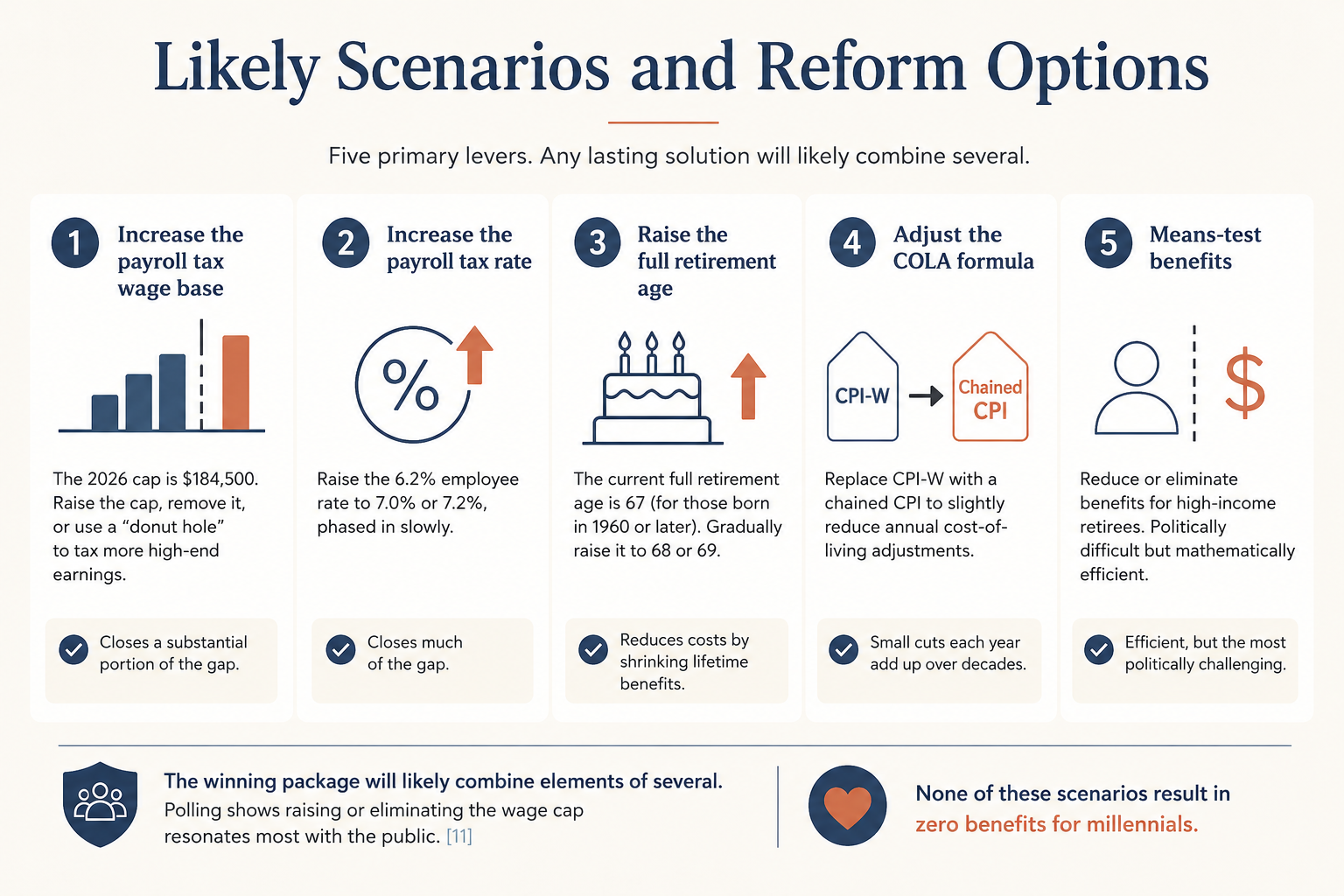
The benefit formula is progressive. A typical earner sees roughly 40% of pre-retirement wages replaced; for the clients I work with, the replacement rate is meaningfully lower because earnings above the taxable maximum ($184,500 in 2026) never enter the calculation. So a 25% haircut on an already-small slice moves the projection less than most clients fear.
But the reform scenarios cut differently. The trustees' current repair menu includes raising the payroll tax rate from 12.4% to 16.65%, trimming benefits 25.2%, or blends of the two, and nearly every serious proposal shields current retirees while concentrating changes on younger and higher-earning workers. For a high-earning 38-year-old, the realistic exposure is higher lifetime payroll taxes plus means-tested benefit trims. That combination affects how much you should defer, where you should locate assets, and how much Roth conversion capacity is worth along the way. The Social Security assumption stops being one line and starts touching the tax plan.
Pricing the Gap Instead of Fearing It
The consumer version of this analysis uses a clean example worth repeating here because the shape holds at any scale. Take a projected benefit of $2,000 a month. A 25% haircut removes $500 a month, or $6,000 a year. At a 4% withdrawal rate, replacing that income permanently requires $150,000 of additional capital, which is 25 times the annual gap.
For a 35-year-old investing in a 90/10 portfolio, using a 9% nominal return converted to 5.8252% real through the Fisher equation at 3% inflation, compounded annually with end-of-year contributions, building $150,000 in today's dollars over 30 years requires $1,956 a year, or $163 a month. Historical averages, not guarantees, and the inputs move with each client's situation. But the planning insight is durable: the entire feared shortfall, priced honestly, usually costs less per month than clients expect, and knowing the price converts anxiety into a line item.
Where Professional Guidance Changes the Outcome
A blog post can hand you the 75% framework. What it cannot do is integrate it: stress-testing your plan at 100%, 75%, and 50% payable; coordinating claiming strategy between spouses whose benefits differ; deciding whether the reform risk argues for more Roth in your specific bracket; and updating the whole structure in the five minutes after each year's Trustees Report instead of never. At Melby Wealth Management, the Social Security assumption is one input in a coordinated plan that covers investments, tax strategy, and the goals the anxiety was crowding out.
Most people who schedule a conversation with us have never worked with a financial advisor before. That's exactly who we work with. If you'd like to discuss your retirement projections, including how Social Security should figure into yours, schedule a meeting.
For the consumer-facing version of this post, head over to Melby Money.
About The Author
Shaun Melby, CFP® provides fee-only financial planning and investment management services in Nashville, TN through his company Melby Wealth Management. Shaun has over 15 years of experience as a financial advisor in Nashville. Shaun created Melby Money to educate the public about finances.
Full Disclosure: Nothing on this website should ever be considered to be advice, research, or an invitation to buy or sell any securities. Please see the Full Disclosure page for a full disclaimer.